What began as a need to reduce the amount of high risk situations while using ‘the Whompus’ roll extractor in the Hot Strip Mill (HSM) to perform Roughing Mill Work Roll changes, ended with higher yielding results than expected. The applied changes have since eliminated the job’s high risk potential for employee injury; removing 108 hazard exposures and increasing overall roll change efficiency by 42 percent.
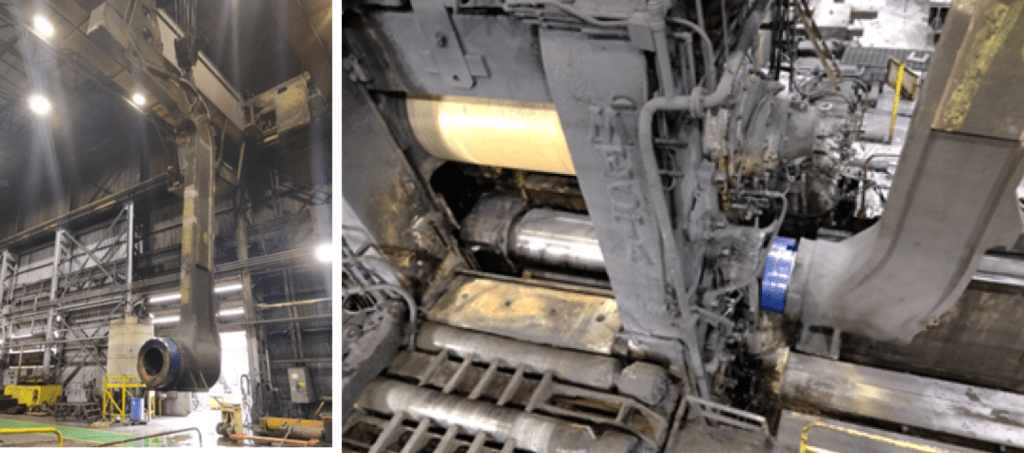
Removing worn work rolls and installing reground work rolls in the Hot Mill used to require the use of a 22-ton roll extractor, which HSM employees call the Whompus. This long-used method required operators to maneuver large 1-3/4” X 40’ cables and a support stand to stabilize the Whompus so it could extract work rolls—leaving employees at high risk for injury.
Finding a solution for this problem was high on the priority list.
“To come up with our project, we tasked employees to identify hazardous tasks performed in the mill,” said HSM Electrical Planner [name]. “Our mill’s Accident Prevention Team then prioritized this list based on the number of incidents for each task presented. We chose the R3-R5 work roll change out because this task had the most incidents and injuries that year. These included a pinched finger while handling the Whompus stand, bent floor plates that have to be removed for bottom roll changes, damage to the valve stand, and more. We knew it was time do something.”
Recognizing the R1-R2 stand mill design is similar to stands R3-R5, the team decided to retrofit the C-hook used to change R1-R2 work rolls with a sleeve adapter. The addition of the sleeve would allow the C-hook to successfully remove and install the smaller-diameter R3-R5 work rolls using only the overhead crane.
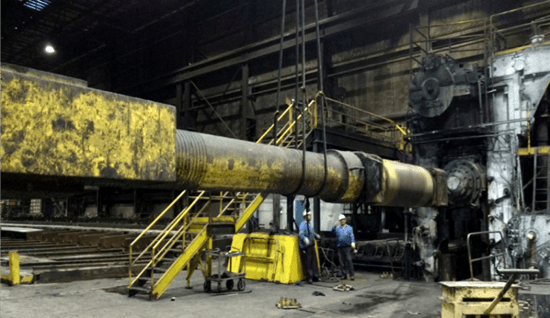
By implementing the retrofitted tool and a new Safe Work Procedure (SWP), the team not only made the job safer for operators, but significantly increased the rate of efficiency when changing out work rolls. The old roll-change process utilizing the Whompus took 35 steps to complete the task with 120 identified hazards ranging from high to low. The new roll-change process utilizing the retrofitted C-hook, however, reduced the number of SWP steps to 19 with only 12 identified hazards ranging from medium to low. All high-risk hazards were eliminated.
The cost to retrofit the existing C-hook by building in-house totaled $12,500—saving [company] $165,000 that would have been required to purchase a new C-hook.
 NaturallyNat