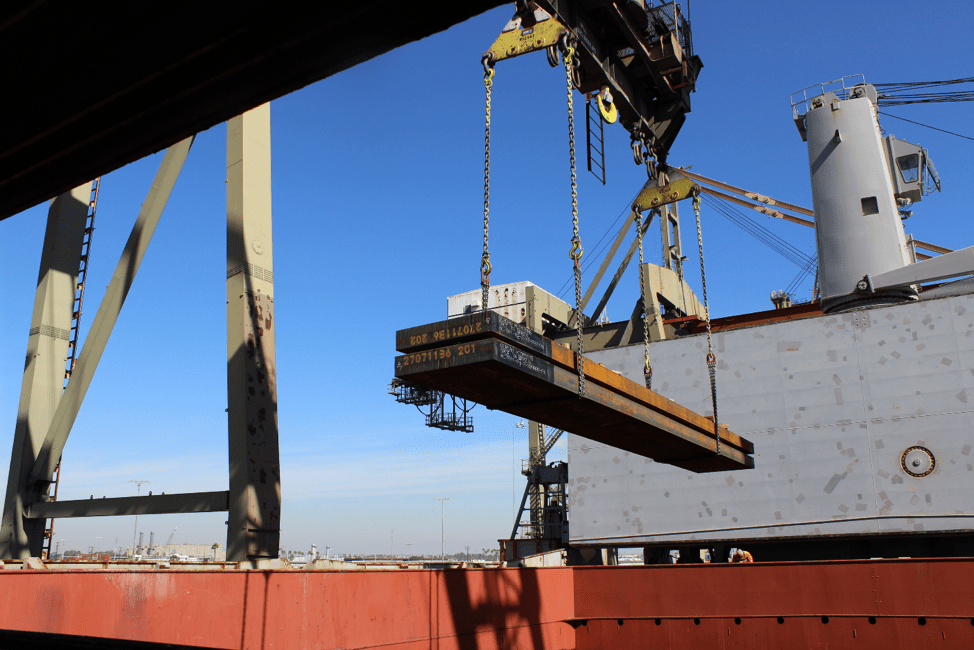
Will imported semi-finished steel now be subject to limitations and tariffs? It’s a question CSI and their partnering vendors from the busiest port in the western United States hope will be answered in the coming days.
The steel industry continues to wait for the verdict from the U.S. Department of Commerce (DOC) on the nationally debated Section 232 investigation into steel imports and whether they pose any threat on national security. The executive memorandum to initiate this investigation was signed in April 2017. Based on the DOC’s recommendation to President Trump, a potential tariff system could be put in place to deter U.S. companies from importing foreign material including semi-finished steel.
As a consistent slab importer, CSI is urging the DOC to exclude their raw material supply from the list of penalized products—and an influx of letters written to the DOC made it clear that one of the busiest ports in the country is supporting their cause.
The Port of Los Angeles, the International Longshore and Warehouse Union, and CSI’s long-time slab logistics vendor Pasha Stevedoring & Terminal (PST) filed formal comments to the DOC’s Bureau of Industry and Security advocating the importance of CSI’s business model in generating jobs and strengthening the western economy.
Excerpt from the Port of Los Angeles’ letter to the DOC—
“The importation of slab steel is an important activity at the Port of Los Angeles. We are not only the leading container port in the nation, but the Port also handles approximately 1.5 million tons of semi-finished steel slabs per year for California Steel Industries—the largest single user of the Port by tonnage. We respectfully ask you to consider the significant impacts of the importation of slab steel on the Port of Los Angeles and the local and regional economy.”
— Excerpt from Pasha Stevedoring & Terminal’s letter to the DOC—
One of the many cargo-handling companies providing services at the Port of Los Angeles is CSI’s slab logistics vendor. PST is the third largest independent West Coast terminal operator, holding several long-term leases with the Port, and employs approximately 350 longshore workers and employees daily with the help of CSI’s business.
“One of the reasons PST is able to protect many of our port jobs is because of the business we get from CSI, one of our most enduring and loyal customers. CSI imports slabs from friendly trading partners—primarily Japan, Mexico and Brazil—and NOT from China. We are asking that the results of your investigation not be used as a justification to place any limitations on the import of semi-finished steel (“slabs”), which are critical to steel supply chains, particularly in the Western U.S.”
— Excerpt from Pasha Stevedoring & Terminal’s letter to the DOC—
There are just four slab converter mills in the U.S., with the two on the West Coast being CSI and Evraz in Portland, Oregon. The transportation process of moving the millions of tons of imported slab from ships to CSI’s doorstep is one that supports organizations in supplying employment opportunities.
“The outcome of the ongoing Section 232 National Security Investigation of Imports of Steel is very important to the ILWU and the hundreds of our workers who move ever-increasing cargo values through the Port of Los Angeles because it has potential to negatively affect California Steel Industries. CSI imports more than 1.5 million tons of slab through the Port annually to support hundred of ILWU jobs, as well as more than 200 downstream customers across the Western U.S. The hundreds of other U.S. steel manufacturers that depend on CSI would either have to reduce business or find new suppliers in the East.
— Excerpt from the International Longshore and Warehouse Union’s letter to the DOC
[The DOC’s] evaluation will ultimately be based on the facts—and the facts show that the import of steel slab as a feedstock for “slab converter” mills like CSI is a natural consequence of changes in the U.S. steel industry that have made the industry stronger against global forces, not weaker.”
CSI will continue to monitor updates on the Section 232 ruling.
 NaturallyNat